

Do You Need a Visa to Visit China? Entry Rules Explained
Do you need a visa to visit China? Start with four facts: the passport you will use, the purpose of your trip, how long you plan to stay and your complete travel route.
Some visitors can enter mainland China under a visa-free policy. Others may qualify for the 240-hour visa-free transit policy. If neither option applies, you will normally need to obtain the appropriate Chinese visa before departure.
Scope: This guide covers entry into mainland China. Hong Kong and Macao have separate immigration and visa rules, so check each part of a multi-destination trip separately.
Explore more practical information in our China Visa Guide, including visa-free entry, transit policies and application tips.
In This Guide
- Quick answer: Do you need a visa?
- Four things to check first
- The main entry options
- Visa-free entry, transit and tourist visas compared
- Transit route examples
- Documents to prepare
- Common mistakes
- Frequently asked questions
- Final check before booking
Quick Answer: Do You Need a Visa to Visit China?
You may not need a visa if your ordinary passport is covered by a current Chinese visa-free policy or your itinerary meets the conditions for visa-free transit.
You will normally need a visa if no exemption applies, your planned stay exceeds the permitted visa-free period, or you are coming to China for work, formal study, news reporting or another activity requiring prior approval.
| Your situation | Likely entry option |
|---|---|
| Your ordinary passport is covered by China’s unilateral visa-free policy | Visa-free entry may be available |
| Your passport is covered by a mutual visa-exemption agreement | Check the exact passport and stay conditions in that agreement |
| You are traveling through China to another country or region | You may qualify for 240-hour visa-free transit |
| You remain inside the restricted transit area for less than 24 hours | The 24-hour visa-free transit policy may apply |
| No exemption applies to your trip | Apply for the appropriate Chinese visa before departure |
| You plan to work, study or report news in China | The relevant visa and prior approval are normally required |
China’s official unilateral visa-free list currently covers ordinary-passport holders from 50 countries for eligible visits of up to 30 days. The permitted purposes include business, tourism, visiting relatives or friends, exchange visits and transit. Check the official unilateral visa-free country list before traveling.
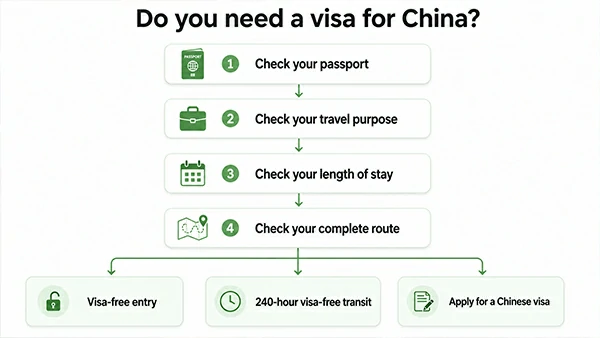
China Visa Requirements: Four Things to Check First
You do not need to memorize every visa rule before planning your trip. Begin with four details that determine which entry option may apply.
The passport you will use
Start with your passport, not the country where you live.
China’s visa-free rules are generally based on the nationality and type of passport presented at immigration. Permanent residence in another country does not automatically give you the same entry rights as a citizen of that country.
For example, a traveler living in Canada but entering China with an Indian passport must check the rules for the Indian passport.
Dual nationals should check the rules for the exact passport they will use for their flight booking, entry into mainland China and onward journey.
China’s unilateral visa-free policy applies to eligible travelers holding a valid ordinary passport. Temporary documents, emergency travel documents and other non-ordinary documents are not automatically covered by the same exemption. The Ministry of Foreign Affairs visa-free entry FAQ explains the document requirements.
The real purpose of your trip
The purpose stated at immigration should match what you actually plan to do in China.
Eligible short visa-free visits can include:
- Tourism
- Short business visits
- Visiting relatives or friends
- Exchange visits
- Transit
Work, formal study and news reporting are not covered by the ordinary short-stay visa-free policy. Those activities normally require prior approval and the correct visa.
A short business visit is also different from taking employment in China. Attending meetings, visiting a supplier or attending a trade exhibition may fit a business visit. Starting a job for a company in China does not.
How long you plan to stay
Eligible travelers using China’s unilateral visa-free policy may stay for up to 30 calendar days.
The period is calculated from 00:00 on the day after entry. If you enter China on May 1, the first counted day is May 2.
Mutual visa-exemption agreements may have different stay limits and conditions. Do not assume every visa-free policy allows the same number of days.
If your planned visit exceeds the period allowed by the policy that applies to you, obtain the appropriate visa before traveling rather than relying on an extension after arrival.
Your complete travel route
Your route is especially important when considering the 240-hour visa-free transit policy.
Country or region A → mainland China → country or region B
The destination after mainland China must be different from the country or region from which you arrived. China must be an intermediate stop on an onward international journey, not simply the turning point of a return trip.
A traveler using visa-free transit must also hold a confirmed onward booking, use eligible ports and remain inside the permitted travel area.
The Main Ways to Enter China Without a Standard Tourist Visa
“Visa-free China” can refer to several different policies. They have different passport, route, purpose and geographic requirements.
Visa-free entry for eligible ordinary-passport holders
China’s unilateral policy currently allows eligible ordinary-passport holders from 50 countries to enter for approved purposes and stay for up to 30 days.
Travelers who meet the conditions do not need to apply to a Chinese embassy in advance solely to use this policy. Border officers may still ask about the purpose of the visit, accommodation and onward or return travel.
China’s official guidance recommends carrying supporting documents such as flight tickets, accommodation reservations or an invitation letter that matches the purpose of the trip.
The country list and the validity periods of individual exemptions can change. Check the official list again shortly before departure rather than relying on an old screenshot, forum post or social-media video.
Mutual visa exemption
China also has mutual visa-exemption agreements with a number of countries.
These agreements are separate from the unilateral policy. An agreement may apply to ordinary passports, diplomatic passports, official passports or only certain passport categories.
The existence of an agreement does not automatically mean every citizen of that country can enter China with an ordinary tourist passport. Check the passport category, permitted stay and notes in the official list of mutual visa-exemption agreements.
240-hour visa-free transit
The 240-hour policy is not a ten-day tourist visa and is not a general visa on arrival.
It is designed for eligible travelers passing through mainland China on their way to a third country or region.
The policy currently covers nationals of 55 countries and can be used through 65 designated ports across 24 provincial-level regions. Eligible travelers may remain in the approved area for up to 240 hours, or ten days, provided they meet all of the conditions.
Before relying on the policy, check:
- Whether your nationality is eligible
- Whether your route continues to a third country or region
- Whether your arrival and departure ports participate in the policy
- Whether every city you plan to visit is inside the permitted area
- Whether you hold a confirmed onward ticket with a departure date and seat
Do not assume that arriving at an eligible airport allows you to travel anywhere in mainland China. Check the latest ports and permitted areas in the official 240-hour visa-free transit policy.
24-hour visa-free transit
China also operates a 24-hour visa-free transit policy for eligible international transit journeys.
Travelers who remain inside the restricted transit area may be able to continue their journey without applying for a Chinese visa. A traveler who needs to leave the restricted area must first request a temporary entry permit from the immigration inspection authority.
A temporary entry permit is not guaranteed. Confirm the airport, connection and document requirements before relying on this option.
A regular Chinese visa
If no exemption fits your trip, apply for the visa category that matches your actual purpose.
- L visa: tourism
- M visa: commercial and trade activities
- F visa: exchanges, visits, study tours and other non-commercial activities
- X visa: study
- Z visa: work
- Q visa: certain family visits involving Chinese citizens or permanent residents
- S visa: certain visits to foreign family members living in China and private matters
- J visa: journalism
Application documents, submission procedures, fees and processing services can vary by application location. Follow the instructions issued by the Chinese embassy, consulate or visa application center responsible for the place where you apply. The official Chinese visa application system asks applicants to select their application city before showing the relevant process.
Visa-Free Entry vs 240-Hour Transit vs Tourist Visa
| Question | Visa-free entry | 240-hour visa-free transit | L tourist visa |
|---|---|---|---|
| Must you apply before departure? | Normally no | Normally no | Yes |
| Is a third-country or third-region route required? | No | Yes | No |
| Can mainland China be your main destination? | Yes, if eligible | No, it must be an intermediate stop | Yes |
| Is the option limited by nationality? | Yes | Yes | Applications are assessed under visa rules |
| Can you travel anywhere in mainland China? | The unilateral policy does not generally impose a transit travel area | No, you must remain inside the permitted area | Subject to the visa and other applicable restrictions |
| Can you take employment in China? | No | No | No |
| Is admission guaranteed? | No | No | No |
A visa-free policy removes the need to obtain a visa in advance under specific conditions. It does not remove immigration inspection or permit activities outside the policy.
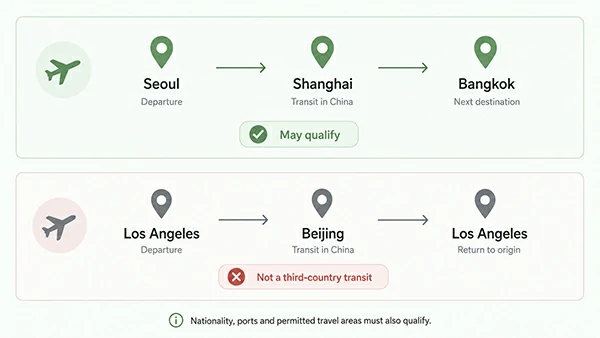
China Transit Route Examples
These examples explain the third-destination requirement. Your passport, arrival port, departure port, onward booking and permitted travel area must still be checked separately.
Seoul → Shanghai → Bangkok
This follows the basic third-destination pattern:
South Korea → mainland China → Thailand
An eligible traveler may be able to use 240-hour visa-free transit if the nationality, tickets, ports and permitted travel area also meet the rules.
Los Angeles → Beijing → Los Angeles
This is a return journey to the same country. It does not normally meet the requirement to transit through China to a third country or region.
The traveler would need to qualify for another visa-free policy or obtain the appropriate Chinese visa.
Tokyo → Shanghai → Hong Kong
This route continues from mainland China to a different region and may fit the basic transit pattern.
The traveler must still confirm nationality eligibility, eligible ports, confirmed bookings and the permitted travel area. Hong Kong’s own entry requirements must also be checked separately.
An eligible visa-free traveler taking a round trip
A round trip does not qualify as a third-destination transit route. However, the traveler may not need the transit policy at all if the passport, purpose and length of stay qualify for ordinary visa-free entry.
Check general visa-free eligibility before trying to make a trip fit the transit rules.
Documents to Prepare Before You Travel
There is no single document checklist for every traveler. You should, however, be able to show a clear and consistent trip.
Keep the following available in printed or offline digital form:
- The passport you will use to enter and leave China
- A valid Chinese visa, if one is required
- Your confirmed return or onward ticket
- Hotel reservations or the address where you will stay
- A simple travel itinerary
- Contact details for your accommodation, host or inviting company
- An invitation letter when relevant
- Documents supporting the purpose of your visit
- Documents required for entry into your next destination
Travelers using 240-hour visa-free transit should make the complete route especially easy to understand. Keep the arrival and onward bookings accessible even if mobile data or airport Wi-Fi is unavailable.
Your bookings, documents and explanation should all describe the same journey.

Common China Visa and Entry Mistakes
Checking your residence instead of your passport
Where you live is not necessarily what determines visa-free eligibility. Check the passport you will actually present at immigration.
Confusing visa-free entry with visa-free transit
Ordinary visa-free entry can allow China to be the main destination. Visa-free transit requires an onward journey to a third country or region.
Assuming a return flight qualifies as transit
A country A → China → country A itinerary does not normally satisfy the third-destination requirement.
Copying another traveler’s route
A route that worked for someone else may not work for you. Their passport, ports, onward destination or permitted travel area may be different.
Using an outdated visa-free country list
China’s visa-free policies have changed several times. Check the official list and make sure it covers your actual travel dates.
Booking internal travel before checking the permitted area
The 240-hour transit policy does not automatically allow travel throughout mainland China. Check every city on your itinerary before booking trains or domestic flights.
Assuming a valid visa guarantees admission
A visa or visa-free exemption allows you to travel to a Chinese port and request entry. The final decision remains subject to immigration inspection.
Frequently Asked Questions
Do you need a visa to visit China?
You may not need a visa if your ordinary passport is covered by a current visa-free policy or your itinerary qualifies for visa-free transit. Otherwise, you will normally need the Chinese visa that matches your travel purpose.
Do you need a visa to go to China for tourism?
Some ordinary-passport holders can currently visit mainland China visa-free for tourism for up to 30 days. Travelers who are not covered, or who plan to stay longer than the permitted period, normally need an L tourist visa.
Can I travel to China visa-free from a country that is not my home country?
Yes. If your passport and trip satisfy the policy, you can travel to China from another country or region. Eligibility is not limited to departures from your country of citizenship.
Do US citizens need a visa for China?
The United States is not included in China’s current unilateral 30-day visa-free country list. For an ordinary trip in which mainland China is the main destination, a US passport holder will generally need a Chinese visa unless another exemption applies.
US nationals are included in the 240-hour visa-free transit policy and may qualify when the route, ports, onward booking and permitted travel area meet all requirements.
Is the 240-hour transit policy a visa?
No. The official term is the 240-hour visa-free transit policy. It allows eligible travelers to enter without obtaining a regular visa in advance, but only when all transit conditions are met.
Can I leave the airport during visa-free transit?
Travelers admitted under the 240-hour policy can leave the airport and travel within the permitted area.
Travelers relying on 24-hour transit may need to remain inside the restricted transit area unless the border inspection authority grants a temporary entry permit.
Can I work in China during visa-free entry?
No. Visa-free tourism, short business visits and transit do not provide authorization to take employment in China. Employment normally requires the relevant work authorization and visa.
Can children enter China without a visa?
Children follow the same basic visa-free eligibility rules as adults. The passport used by the child must meet the relevant policy conditions.
Do I need to contact a Chinese embassy before using visa-free entry?
Travelers who fully meet the unilateral visa-free conditions do not need to make an advance declaration to a Chinese embassy or consulate solely to use that policy. You should still verify the current rules and prepare documents supporting your journey.
Does a Chinese visa guarantee entry?
No. Possession of a valid visa does not guarantee admission. The final entry decision is made by the border inspection authority based on the traveler’s documents and circumstances.
If you are still asking “do you need a visa to visit China”, check your passport, travel purpose, stay length and route before booking your trip.
Final Check Before Booking Your Trip
Before paying for non-refundable flights or hotels, confirm each point:
- I checked the rules for the exact passport I will use.
- I confirmed that my travel purpose is permitted.
- I checked how many days I can stay.
- I reviewed my complete arrival and departure route.
- I confirmed whether mainland China is my destination or a transit stop.
- I checked the arrival and departure ports.
- I confirmed that every planned city is inside the permitted travel area.
- I have a confirmed return or onward booking.
- I saved my accommodation and itinerary information offline.
- I checked the entry requirements for my next destination.
Do not choose an entry option based on nationality alone. Your passport, purpose, length of stay and complete route must all fit the same policy.
Once you know which option is most likely to apply, continue with the detailed guide for China visa-free countries, 240-hour visa-free transit or the China tourist visa application process.
Official Sources
Visa and entry policies can change. Use the following official sources to verify the rules for your passport, travel dates and route:
- National Immigration Administration: List of Countries Covered by Unilateral Visa Exemption
- National Immigration Administration: 24-Hour and 240-Hour Visa-Free Transit Policies
- Ministry of Foreign Affairs: FAQs on Visa-Free Entry into China
- Ministry of Foreign Affairs: List of Mutual Visa-Exemption Agreements
- Ministry of Foreign Affairs: Chinese Visa Categories
- Official Chinese Visa Application System
Need Help Preparing for Your China Trip?
ChinaTravelAI provides practical support with visas, eSIM setup, payments, transport, bookings, travel apps, and other questions that often cause problems for first-time visitors.